India's enforcement agencies have never been more aggressive. The Enforcement Directorate filed over 5,000 money laundering cases between 2019 and 2024. SFIO arrested executives from the Amrapali Group. SEBI tightened insider trading rules in June 2025. And with the Bharatiya Nyaya Sanhita (BNS) replacing the IPC from July 2024, the criminal law landscape for white collar offences has been fundamentally rewritten.
Whether you face an ED summons, an SFIO investigation, a SEBI show-cause notice, a CBI probe, or a corporate fraud allegation — the single most important decision you will make is choosing the right White Collar Crime Lawyer India. At the Law Offices of Advocate Naresh Kalra, with offices in Chandigarh, Mohali, and Ludhiana, we provide specialized financial crime defence to executives, promoters, and businesses across Punjab and Pan-India — covering what white collar crime is under Indian law in 2025, which agencies investigate it, what the penalties are, and how to build a defence that protects both your liberty and your assets.
White collar crime refers to financially motivated, non-violent offences committed by individuals, corporate entities, or government officials using positions of authority, trust, or access to information. The term was coined by criminologist Edwin Sutherland in 1939 — but in India's 2025 legal landscape, these crimes are prosecuted under a mesh of specialized statutes that carry penalties reaching up to ₹2,500 crore in fines and 10 years in imprisonment.
Financial fraud and corporate deception (cheating, criminal breach of trust — BNS Sections 316-318), money laundering — proceeds of crime (PMLA 2002), insider trading and market manipulation (SEBI Act 1992 / PIT Regulations), corporate fraud and misappropriation (Companies Act 2013 — Section 447), bribery and public corruption (Prevention of Corruption Act 1988), tax evasion and undisclosed foreign assets (Income Tax Act 1961 / Black Money Act 2015), cyber-enabled financial fraud (IT Act 2000 / BNS), benami transactions and asset concealment (Benami Transactions Act 1988, amended 2016), data theft and privacy violations (DPDP Act 2023 — fines up to ₹2,500 crore), and anti-competitive conduct and cartel behaviour (Competition Act 2002).
Sanhita (BNS), Bharatiya Nagarik Suraksha Sanhita (BNSS), and Bharatiya Sakshya Adhiniyam (BSA) replaced the IPC, CrPC, and Indian Evidence Act respectively. Every White Collar Crime Lawyer India must now operate under this new statutory framework. Our team in Chandigarh and Ludhiana handles cases under both frameworks — existing cases filed before 1 July 2024 continue under the old code, making dual-framework expertise essential.
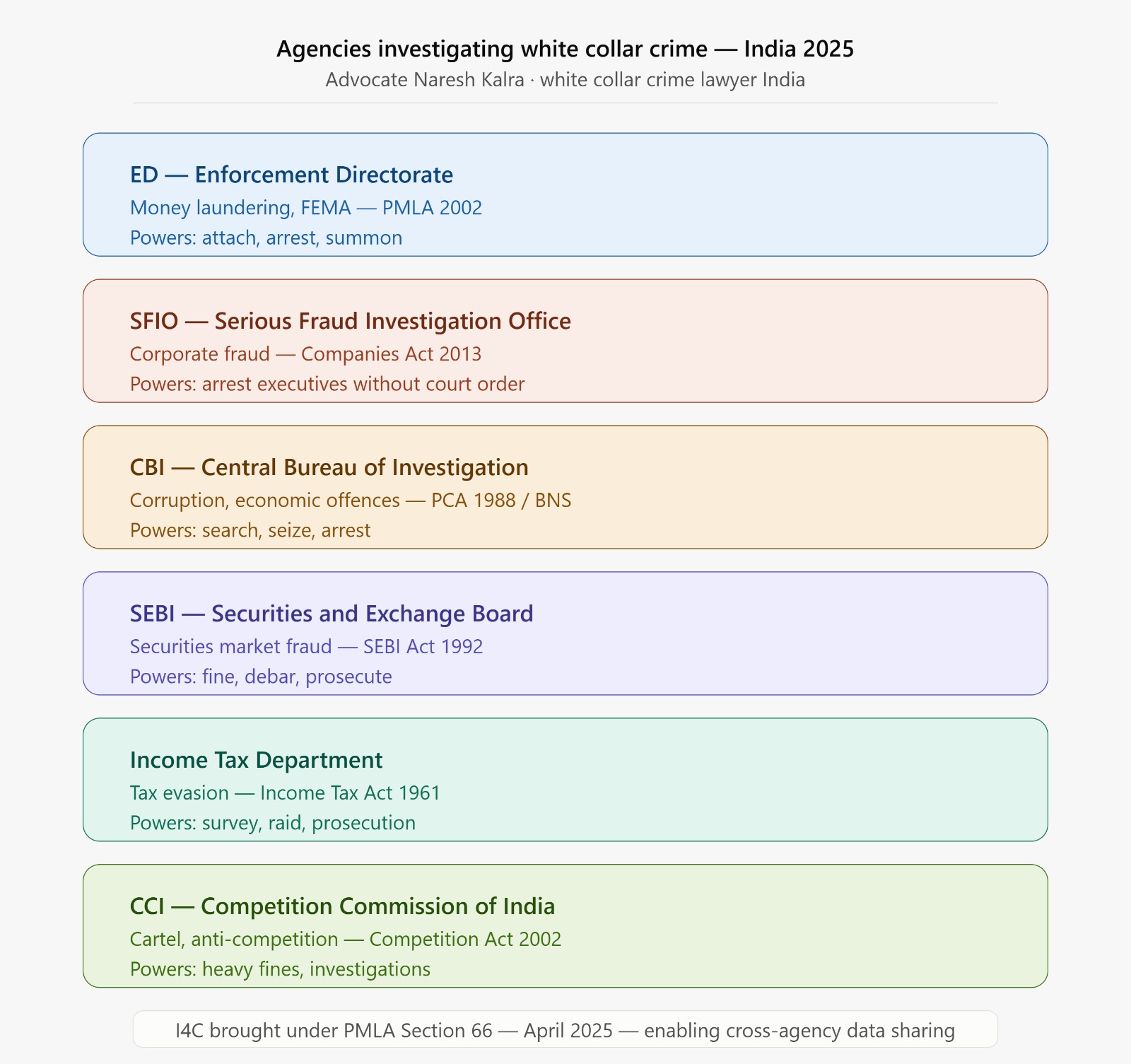
India's white collar enforcement ecosystem involves multiple agencies with overlapping jurisdiction — and a skilled White Collar Crime Lawyer India must know how to navigate all of them simultaneously. As your Financial Fraud Lawyer India team in Chandigarh, we have direct experience before each of these forums:
The ED (Enforcement Directorate) handles money laundering and FEMA matters under PMLA 2002, with powers to attach, arrest, and summon. SFIO investigates corporate fraud under the Companies Act 2013, with powers to arrest executives directly. CBI handles corruption and economic offences under the PCA 1988 and BNS, with powers to search, seize, and arrest. SEBI handles securities market fraud under the SEBI Act 1992, with powers to fine, debar, and prosecute. The Income Tax Department handles tax evasion under the IT Act 1961, with powers to survey, raid, and prosecute. The CCI handles cartel and anti-competitive conduct under the Competition Act 2002, with powers to impose heavy fines and conduct investigations.
The key 2025 enforcement development: on 25 April 2025, the Ministry of Finance brought the Indian Cyber Crime Coordination Centre (I4C) under Section 66 of PMLA — enabling direct information sharing between cyber crime units and the ED. This dramatically expands the reach of financial crime investigations into digital and online fraud, and our team in Chandigarh and Mohali tracks these developments closely for every client we represent.
Understanding what is at stake is the first step in building a defence. India's 2023–2025 amendments have significantly increased both fines and imprisonment terms across every major category of white collar offence. Money laundering under PMLA 2002 carries up to 10 years imprisonment plus property attachment, investigated by the ED. Corporate fraud under the Companies Act 2013 carries up to 10 years plus ₹10 crore fine, investigated by SFIO. Insider trading under the SEBI Act and PIT Regulations carries fines up to ₹25 crore or three times the profit made, investigated by SEBI. Bribery and corruption under the PCA 1988 and BNS carries up to 7 years imprisonment, investigated by CBI or the Economic Offences Wing. Tax evasion under the Income Tax Act 1961 carries up to 7 years imprisonment, investigated by the IT Department. Cyber financial fraud under the IT Act 2000 and BNS carries up to 3 years plus fine, investigated by Cyber Crime Units. Data privacy breaches under the DPDP Act 2023 carry fines up to ₹2,500 crore, investigated by the Data Protection Board. Benami transactions under the Benami Act 1988 (amended 2016) carry up to 7 years plus property confiscation, investigated jointly by the IT Department and ED.
Critical note on reverse onus: under the PMLA, Benami Act, and Black Money Act, the burden of proof shifts to the accused. You must prove the money or property is not proceeds of crime — not the other way around. This is why engaging an experienced PMLA Lawyer India in Chandigarh or Ludhiana immediately after receiving notice is non-negotiable.
India's courts delivered several critical rulings in 2025 that directly affect how white collar defence strategy must be structured, and our practice in Chandigarh tracks every one of these closely.
Most civil advocates can handle property disputes or contract litigation. Very few are equipped to handle the complexity of a multi-agency white collar investigation. As an established Corporate Fraud Lawyer India practice based in Chandigarh, here is what separates our approach from general practitioners:
As Money Laundering Defence Lawyer India based in Chandigarh, Mohali, and Ludhiana, we handle the full spectrum of financial and corporate crime:
The worst mistake in any white collar investigation is delay. Every hour without legal counsel creates risk. Here is the exact action sequence our White Collar Crime Lawyer India team in Chandigarh executes: contact us immediately before responding to any summons or notice; do not destroy, delete, or alter any documents, emails, or financial statements, as this constitutes obstruction; preserve all communications even those unfavourable to your position, since selective deletion is easily detected forensically; file an anticipatory bail application if arrest is a risk under Section 438 BNSS; respond to ED summons under PMLA Section 50 with legal counsel present, since your statement can be used as evidence; challenge overbroad attachment orders, as provisional attachment under PMLA Section 5 can be contested before the Adjudicating Authority within 30 days; coordinate responses across agencies if ED, SFIO, and CBI are all active; assess settlement options including SEBI's compounding mechanism and tax regularisation schemes; build the documentary defence through a complete audit of financial records; and challenge illegal arrests or procedurally defective notices, as courts have consistently quashed ED arrests where Section 19 PMLA procedures were not followed.
Critical warning — reverse onus under PMLA: Under the Prevention of Money Laundering Act, the burden of proof is reversed — you must prove the money or property is not proceeds of crime. The Supreme Court upheld this in Vijay Madanlal Choudhary vs Union of India (2022), and it remains binding law in 2025. This makes pre-investigation compliance structuring and early legal intervention from our Chandigarh team far more valuable than post-arrest defence.
The most cost-effective use of a White Collar Crime Lawyer India is before any investigation begins. Our Corporate Fraud Lawyer India practice in Chandigarh helps businesses across Punjab with anti-money laundering compliance frameworks and KYC policy drafting, internal investigation protocols and whistleblower mechanisms under the Companies Act 2013, director liability audits identifying which board members face personal criminal exposure, SEBI compliance audits for listed companies covering trading window policies, PMLA beneficial ownership mapping (the 2023 PMLA Rules cut the beneficial owner threshold to 10%), DPDP Act 2023 compliance for significant data fiduciaries, transaction due diligence in mergers and acquisitions, and cross-border compliance protocols for companies with international operations.
White collar crimes are financially motivated, non-violent offences committed using positions of authority, trust, or access to financial systems — fraud, money laundering, insider trading, corporate fraud, tax evasion. They are prosecuted under specialised statutes like PMLA, Companies Act 2013, SEBI Act, and PCA rather than only the general BNS, which replaced the IPC from July 2024. The key legal distinction is that many white collar statutes carry reverse onus provisions — the accused must prove innocence, unlike standard criminal law. Our White Collar Crime Lawyer India team in Chandigarh structures defence strategy around this distinction from day one.
Do not obstruct officers, as this creates an additional offence. Do not sign any statement without your lawyer present. Do not delete any digital records. Call your White Collar Crime Lawyer India team immediately. Note the names of all officers present and the exact documents seized. Our team will challenge the raid's legality if procedural requirements under PMLA Sections 17–18 were not followed. The first 24–48 hours determine whether you maintain bail eligibility and control over your narrative.
Yes — anticipatory bail under Section 438 BNSS is available in white collar cases unless the offence is non-bailable and the court finds specific grounds against bail. Under PMLA, however, the bail standard is stricter — Section 45 PMLA requires the court to be satisfied that there are reasonable grounds for believing the accused is not guilty and is unlikely to commit any offence while on bail. Our PMLA Lawyer India team in Chandigarh has secured anticipatory bail for clients across Punjab through detailed evidentiary preparation.
Investigations can span from several months to over a decade depending on complexity, the volume of evidence, cross-border elements, and the number of agencies involved. ED investigations in major PMLA cases routinely run 5–8 years. SFIO investigations under the Companies Act are given priority — all other agencies must await SFIO completion. Our goal as your ED Case Lawyer India team in Chandigarh is to secure bail early, challenge the scope of investigation, and pursue settlement mechanisms where available to compress the timeline.
PMLA Section 45 imposes a twin condition for bail — the public prosecutor must be given an opportunity to oppose, and the court must be satisfied that there are reasonable grounds to believe the accused is not guilty and is unlikely to commit any offence while on bail. The Supreme Court has interpreted this strictly. In Sarla Gupta (2025), the court also affirmed the accused's right to access investigation documents — which our team uses to demonstrate the weakness of the prosecution case in bail hearings.
Under the Companies Act 2013 Section 447, companies and their officers can both be prosecuted for corporate fraud. Under PMLA, legal entities can be named as accused. SEBI can debar, fine, and prosecute companies and promoters. However, parent companies cannot be held liable for the criminal acts of subsidiaries unless evidence shows the parent actively directed or controlled the subsidiary's unlawful conduct — a principle affirmed by Indian courts in 2024–25. Our Corporate Fraud Lawyer India team in Chandigarh advises companies on this liability boundary as part of compliance structuring.
The Serious Fraud Investigation Office investigates offences specifically under the Companies Act 2013 — corporate fraud, financial statement manipulation, auditor misconduct. Unlike CBI, SFIO can arrest executives without a court order under Section 212(8) of the Companies Act. Once SFIO takes up a case, all other agencies must await its completion, giving it priority jurisdiction. CBI operates under the Delhi Special Police Establishment Act 1946 and investigates PCA corruption, BNS economic offences, and cases of public importance. Our team in Chandigarh handles both forums regularly.
Verify the advocate's specific experience with ED, SFIO, SEBI, and CBI cases — not just general civil or criminal litigation. Ask for examples of anticipatory bail obtained in white collar cases. Confirm familiarity with the 2024 BNS/BNSS/BSA framework. Check experience with digital evidence and forensic accounting. At the Law Offices of Advocate Naresh Kalra in Chandigarh, Mohali, and Ludhiana, our team brings direct multi-agency litigation experience to every white collar matter we accept.

India's white collar enforcement landscape in 2025 is the most aggressive it has ever been. ED PMLA cases, SFIO corporate investigations, SEBI insider trading prosecutions, and CBI corruption probes are all operating simultaneously with expanded powers, digital forensics capabilities, and international cooperation through INTERPOL Red Notices — 107 of which were issued at India's request in 2024 alone.
The reverse onus clauses in PMLA, Benami Act, and Black Money Act mean that in the most common white collar investigations, you must prove your innocence, not the other way around. Every hour without specialist legal counsel is an hour of lost strategic ground.
Whether you are an executive facing an ED summons, a promoter whose company is under SFIO investigation, a listed company director navigating a SEBI show-cause notice, or a business owner protecting your assets — the right White Collar Crime Lawyer India makes the difference between a managed legal outcome and a decade of multi-agency litigation.