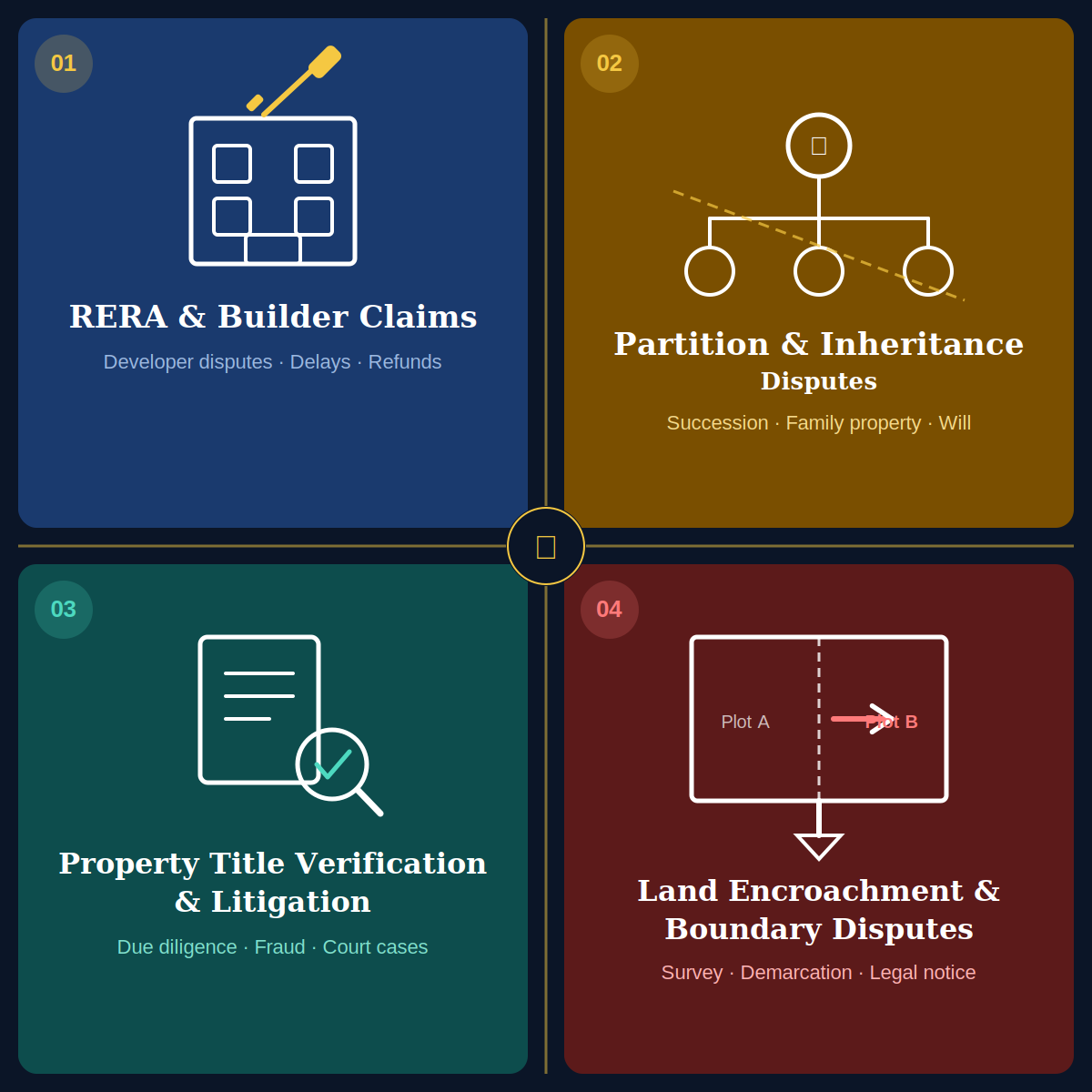
Comprehensive Property Litigation Services
Beyond RERA, the Law Offices of Advocate Naresh Kalra manages the full spectrum of civil, revenue, and constitutional
property law matters across Punjab, Haryana, Chandigarh, and across India. As a seasoned Property Dispute Lawyer India, we handle:
Partition Suit Lawyer India — Ancestral & Family Property Division
A partition suit is one of the most legally complex civil proceedings in Indian property law. The division of ancestral property requires
careful analysis of succession laws (Hindu Succession Act, 1956), determination of coparcenary shares,
and impleadment of all necessary parties. Our firm provides comprehensive legal strategy for fair and equitable partition, ensuring that:
- All coparceners and legal heirs are properly identified and impleaded
- Claims of self-acquired versus ancestral property are clearly established
- Preliminary decrees for partition are obtained and followed through to final decrees
- Future legal challenges to the partition are preemptively addressed in the drafting
Property Title Dispute Lawyer India — Clear Title, Secure Investment
A property title dispute can surface years after a transaction — triggered by forged sale deeds, undisclosed mortgages, benami
transactions,
or competing claims from legal heirs. Before you buy, sell, or invest, ensure that your title is legally unimpeachable. Our firm provides:
- Comprehensive title due diligence and legal opinion for proposed transactions
- Litigation before civil courts for declaration of title and cancellation of fraudulent documents
- Injunctions to prevent illegal sale or encumbrance of disputed property
- Assistance in mutation proceedings before revenue authorities in Punjab and Haryana
Land Dispute Lawyer India — Encroachment, Boundaries & Agricultural Land
Land disputes in Punjab and Haryana often involve illegal encroachment by neighbours, disputed jamabandi entries in revenue records, agricultural
land acquisition by government authorities, and boundary disagreements between co-owners. As a focused Property Litigation Lawyer India, we:
- File suits for permanent injunction and possession restoration before civil courts
- Challenge incorrect revenue entries before Revenue Courts and the Financial Commissioner
- Handle land acquisition disputes and compensation claims under the Right to Fair Compensation Act, 2013
- Pursue criminal complaints for illegal encroachment under relevant provisions of IPC and local laws
Property Registration Fraud & Document Forgery
The forgery of sale deeds, power of attorney documents, and gift deeds is an increasing problem across urban and peri-urban areas in
Punjab. We prosecute property registration fraud cases through a combination of civil
and criminal proceedings, ensuring that fraudulent documents are cancelled and the victim's ownership rights are restored and protected.