Frequently Asked Questions (FAQs)

Can an NRI register a One Person Company in India?

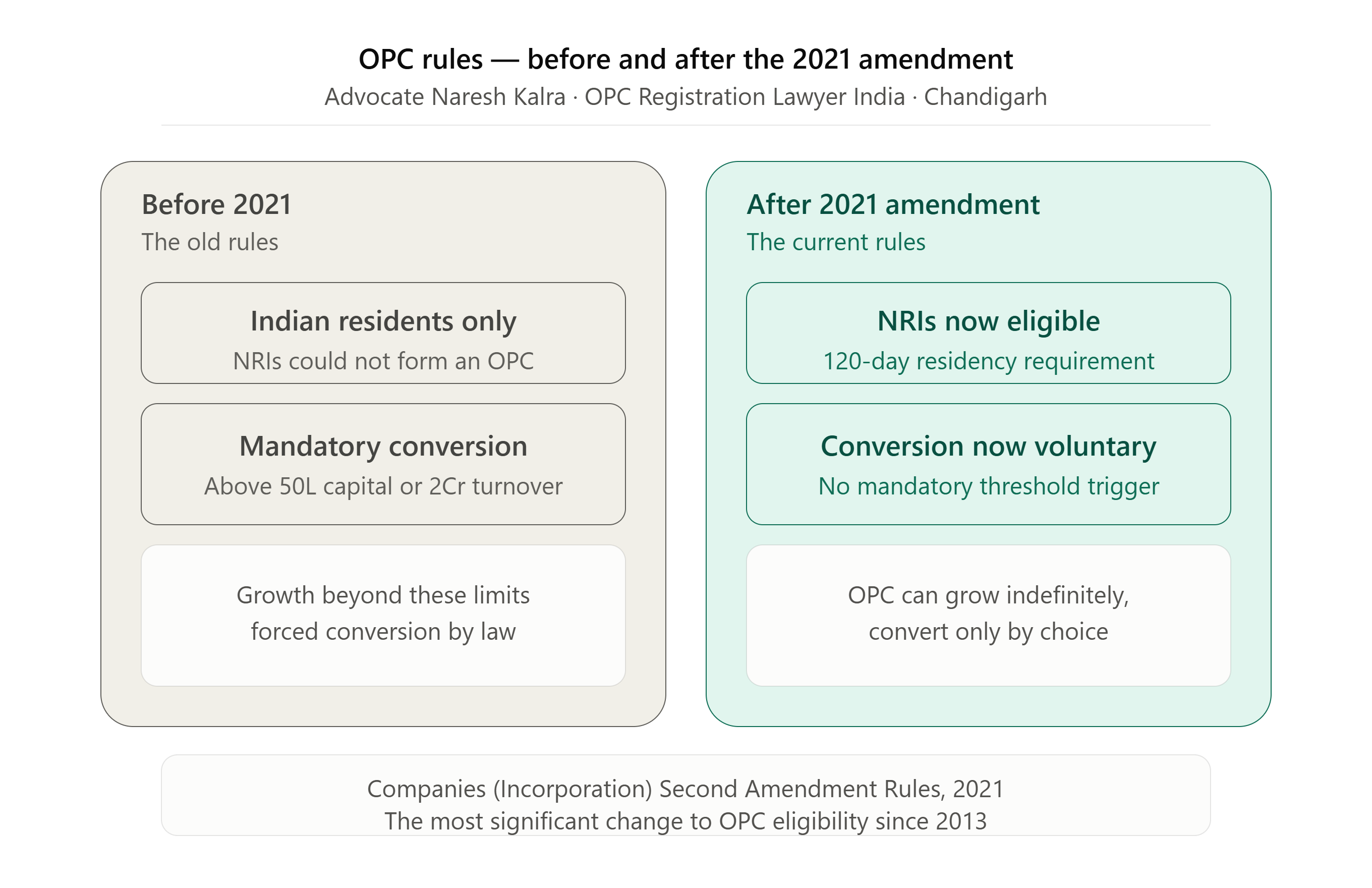
Yes. Following the Companies (Incorporation) Second Amendment Rules, 2021, Non-Resident Indians are now permitted to incorporate an OPC, with the residential requirement reduced to 120 days in the preceding financial year for NRI promoters, compared to 182 days for resident Indian promoters. Our OPC Registration Lawyer India team in Chandigarh advises NRI entrepreneurs on this pathway, which has opened OPC formation to a significantly wider pool of founders.

Does an OPC have to convert to a private limited company once it grows large?

No — not anymore. Prior to 2021, OPCs were mandatorily required to convert into a private limited company once paid-up capital exceeded ₹50 lakh or turnover exceeded ₹2 crore. The Companies (Incorporation) Second Amendment Rules, 2021 removed this mandatory conversion trigger entirely. An OPC can now grow indefinitely while remaining an OPC, and conversion to a private limited company is purely a voluntary business decision — typically made when the founder wants to raise equity funding, which OPCs cannot do since they cannot issue shares.

What is the difference between an OPC and a sole proprietorship?

The core difference is liability protection and legal identity. A sole proprietorship offers no separation between the owner and the business — personal assets are fully exposed to business debts. An OPC creates a genuine separate legal entity with limited liability, shielding personal assets, while still allowing single-person ownership and control. Our OPC vs Sole Proprietorship advisory helps founders in Chandigarh and Ludhiana weigh the modest additional compliance of an OPC against this significant liability protection.

Can an OPC raise funding from investors?

OPCs face a structural limitation here, similar to LLPs — since an OPC cannot issue shares to multiple shareholders, traditional venture capital or private equity funding is generally not accessible in the OPC structure. OPCs can still access business loans and certain funding instruments more easily than an unregistered sole proprietorship. Businesses planning to raise institutional equity eventually convert to a private limited company — a voluntary decision, not a legal requirement, following the 2021 amendment.

What sectors are OPCs restricted from operating in?

OPCs are barred from engaging in financial sector activities — including operating as a Non-Banking Financial Company (NBFC), insurance business, or investment company. This restriction was not affected by the 2021 amendment and remains a firm structural limitation. Our OPC Registration Lawyer India team in Chandigarh advises founders in regulated sectors on whether an OPC or an alternative structure better fits their specific business activity.

Whatsapp Chat