What Separates India's Best Arbitration Lawyers from Average Civil Advocates
Many clients hire a general civil advocate for arbitration — and regret it. Arbitration is not litigation; it has its own procedural
law, evidence standards, drafting requirements, and strategic framework. Here is what India's best arbitration lawyers do differently:
Master the Arbitration Clause Before the Dispute
The arbitration clause is the map for the entire dispute. A skilled civil advocate for arbitration in India reads it for:
seat and venue of arbitration, governing law, number and method of arbitrator appointment, scope of arbitrable disputes,
pre-arbitration notice requirements, and institutional vs. ad hoc rules.
A vague or defective clause can make your entire claim procedurally vulnerable — before you even get to the merits.
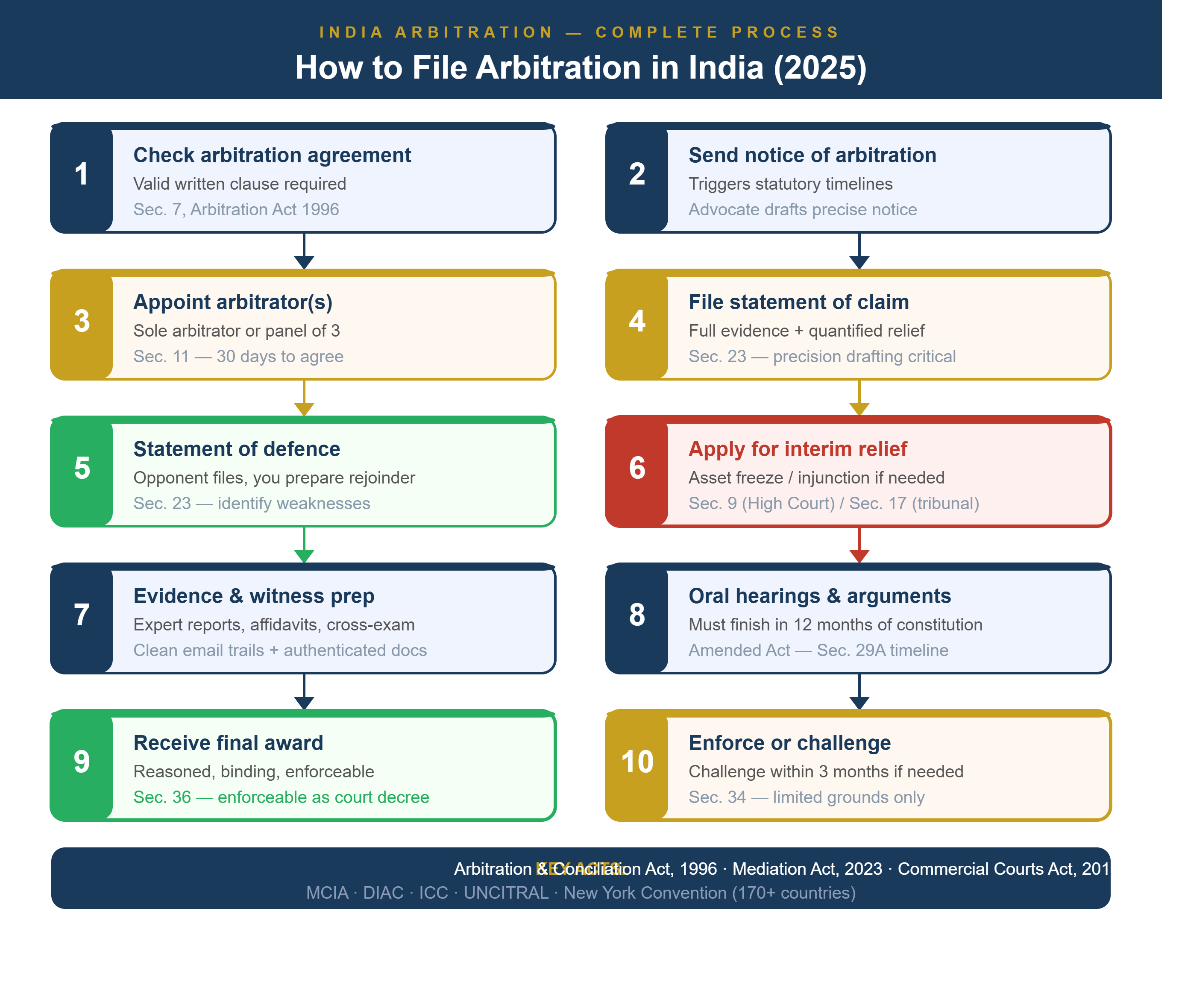
Strategic Arbitrator Selection (Section 11, Arbitration Act 1996)
Choosing the right arbitrator is arguably the most decisive factor in Indian arbitration. Top arbitration lawyers in India know which
retired judges or domain experts are best suited for construction disputes, IT contract conflicts, or corporate shareholder matters.
Under Section
11, if parties fail to agree, the relevant High Court or designated institution appoints — making early strategic agreement essential.
Airtight Pleadings — Statement of Claim and Defence
Most arbitrations are won or lost on paper — in the Statement of Claim or Statement of Defence — before a single oral hearing takes
place. India's best arbitration lawyers draft with surgical precision: clear legal claims,
properly authenticated documentary evidence, quantified relief, and airtight factual chronologies that leave no procedural gaps.
Interim Relief Strategy (Sections 9 and 17)
Interim relief — asset freezing, injunctions, protection of bank guarantees, status quo orders — can be the most decisive tactical
move in Indian arbitration. Your advocate applies under Section 17 before the tribunal (once constituted) or Section 9 before the
High Court
(before or during arbitration). Getting or blocking interim relief early often determines whether the other party settles or fights.
Evidence Discipline — Emails, Expert Reports, Witnesses
Top arbitration lawyers treat evidence like a surgical instrument — not a stack of documents. Clean email trails, authenticated work
orders, expert reports from credible professionals, properly sworn witness affidavits,
and structured cross-examination plans. Sloppy evidence handling is the single biggest cause of strong cases producing weak awards.
Enforcement and Post-Award Strategy (Section 36)
Winning the award is step one. Collecting on it is step two — and often harder. India's best arbitration lawyers plan for enforcement
from day one: ensuring the award is properly reasoned, the claim is precisely quantified, and the
award is structured to withstand a Section 34 challenge. Post-award, they enforce under Section 36 or defend enforcement with precision.