If you are a victim of online fraud, hacking, or harassment — or you have been wrongly accused of a cybercrime — you need a Cyber Crime Lawyer India who understands both the law and the technology behind it. Digital offences move fast, evidence can be altered or deleted within hours, and India's Information Technology Act, 2000 works alongside the newly enacted Bharatiya Nyaya Sanhita (BNS) 2023 to create a legal framework that demands genuine technical fluency, not just courtroom experience.
At the Law Offices of Advocate Naresh Kalra, we represent both victims and accused persons in cybercrime matters across Chandigarh, Mohali, Ludhiana, and Pan-India. Our Cyber Crime Lawyer India practice combines deep familiarity with the IT Act 2000, digital forensics procedures, and the post-2024 criminal law framework to deliver the urgency, precision, and technical understanding that digital cases demand.
Whether you are dealing with a financial fraud, a data breach, online harassment, or a wrongful hacking accusation, the speed and skill of your legal response often determines the outcome.
Cybercrime in India is governed primarily by the Information Technology Act, 2000 (as amended in 2008), working alongside the Bharatiya Nyaya Sanhita 2023, which replaced the Indian Penal Code from 1 July 2024. As your IT Act Lawyer India in Chandigarh, we work across both frameworks:
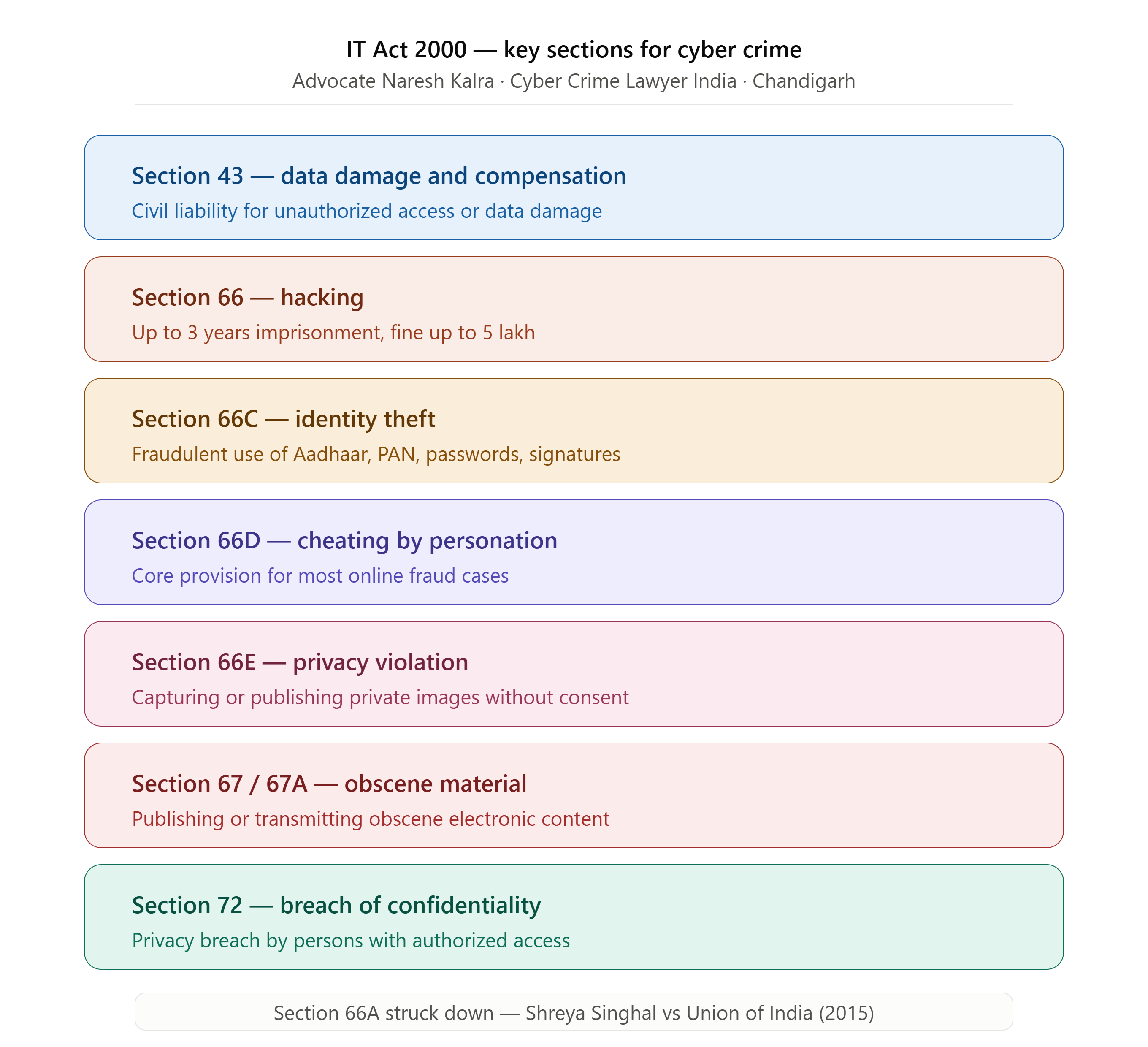
Section 43 IT Act — imposes civil liability and compensation for unauthorized access, data damage, or introduction of viruses into a computer system. Section 66 — criminalizes computer-related offences including hacking, with imprisonment up to 3 years. Section 66B — punishes dishonestly receiving stolen computer resources or communication devices. Section 66C — criminalizes identity theft, including fraudulent use of another person's Aadhaar, PAN, password, or digital signature. Section 66D — punishes cheating by personation using computer resources, the core provision for most online fraud cases. Section 66E — criminalizes violation of privacy, including capturing or publishing images of a person's private area without consent. Section 67 — punishes publishing or transmitting obscene material in electronic form. Section 67A — imposes stricter penalties for sexually explicit material. Section 72 — punishes breach of confidentiality and privacy by persons with authorized access to electronic records.
For offences that also involve deception, forgery, or stalking, the relevant BNS 2023 provisions apply alongside the IT Act — including stalking provisions under BNS that carry enhanced penalties for repeat online offenders.
A critical clarification for accused persons: Section 66A of the IT Act, which criminalized sending "offensive" messages online, was struck down as unconstitutional by the Supreme Court in Shreya Singhal vs Union of India (2015) 5 SCC 1 — yet some police stations across India, including in Punjab, continue to erroneously register FIRs under this defunct section. Our Cyber Crime Lawyer India team in Chandigarh routinely challenges such misapplied charges at the earliest opportunity, securing quashing where the section itself no longer exists in law.

As a Cybercrime Advocate India serving clients across Chandigarh, Mohali, and Ludhiana, our practice covers the full spectrum of digital offences
Cybercrime cases are unlike conventional criminal matters — there is no physical evidence, no eyewitnesses, and no visible crime scene. As your IT Act Lawyer India practice in Chandigarh, we build every case on digital forensic foundations:
You can file a complaint through India's National Cyber Crime Reporting Portal at cybercrime.gov.in, or call the 1930 national helpline for urgent financial fraud cases — early reporting significantly improves the chance of freezing stolen funds. For serious matters, filing a formal FIR at the nearest police station or dedicated cyber crime cell is also advisable. Our Cyber Crime Lawyer India team in Chandigarh assists with both online portal filing and formal FIR drafting to ensure your complaint is legally complete from the outset.
Hacking and unauthorized computer access are punishable under Section 66 of the IT Act 2000 with imprisonment up to 3 years, a fine up to ₹5 lakh, or both. Where the hacking involves identity theft or financial fraud, additional charges under Sections 66C or 66D can apply, and where it involves BNS provisions for cheating or forgery, penalties can increase further. Our Hacking Case Lawyer India team in Chandigarh advises on the specific charges applicable to each case's facts.
Yes, anticipatory bail under Section 482 BNSS (formerly Section 438 CrPC) is available for most cybercrime offences, since the majority of IT Act provisions are bailable or carry moderate sentences. However, offences involving Section 67A (sexually explicit content) or those linked to serious BNS provisions may face stricter scrutiny. Our team has secured anticipatory bail for individuals wrongly implicated due to shared devices, open networks, or misattributed IP addresses — a surprisingly common scenario in Indian cybercrime cases.
No. Section 66A, which criminalized sending "offensive" messages through communication services, was struck down as unconstitutional by the Supreme Court in Shreya Singhal vs Union of India (2015). Despite this, some police stations across India continue to erroneously register FIRs under this defunct provision. If you have been charged under Section 66A, our Cyber Crime Lawyer India team in Chandigarh can move immediately to have such charges quashed, since the provision no longer exists in law.
Immediately engage legal counsel to assess both criminal complaint options under the IT Act and compliance obligations under the Digital Personal Data Protection Act 2023, which may require breach notification and can carry penalties up to ₹250 crore for significant data fiduciaries. Preserve all system logs and evidence, avoid public statements before legal review, and coordinate with forensic investigators. Our Data Breach Lawyer India team in Chandigarh and Mohali advises businesses on this dual-track response — criminal prosecution of the perpetrator alongside regulatory compliance for the affected organization.
Timeline varies significantly based on complexity, the volume of digital evidence, and whether the matter is a straightforward FIR-based prosecution or involves cross-border elements. Simple financial fraud complaints with prompt fund-freezing can resolve within months. Complex hacking or data breach cases involving extensive forensic analysis can take 2-4 years through trial. Our Cyber Crime Lawyer India team in Chandigarh prioritizes early evidence preservation and prompt filing to avoid unnecessary procedural delays.
Cybercrime is not just a digital inconvenience — it is a serious legal threat to your finances, reputation, and liberty. Whether you are recovering from online fraud, protecting your business from a data breach, or defending against a wrongful digital accusation, the right legal response — filed quickly and argued with genuine technical understanding — makes the difference between resolution and prolonged uncertainty.
The Law Offices of Advocate Naresh Kalra, with offices in Chandigarh, Mohali, and Ludhiana, are ready to assess your cybercrime matter immediately and pursue the fastest, most technically sound path to resolution.